Bali Hai

The cotton wool clouds, the fine grains of black volcanic sands, the clean sea waters - one can just lie on the beach and while the time away with a tan beneath the balmy tropical sun...

The Volcanic Islets Of Onuma

Ōnuma Park is known for its picturesque, island dotted lakes and majestic dormant volcano, Mount Komagatake. Surrounded by birch and maple forests, a total of 128 small islands can be found in its lakes...

A Journey Over Mountains & Waters

A land of rocky mountains, snaking rivers, steep slopes, deep valleys, and harsh barren terrain. Yet in some places, lush greenery and crystal-clear azure waters abound...

The Bluest Pacific Seas

In the middle of the Pacific Oceans lies an archipelago of islands formed from the fiercest violent volcanoes and made of the browns and greys of cooled lava rocks. The resulting landscape is breathtaking in its purest greens and blues...

Sounkyo's Silver Streams

Bordered by 100-metre cliffs formed by the erosion of tuff, Sounkyo Gorge is situated at the foot of Mount Daisetsuzan - the "roof of Hokkaido", and stretches for 24 kilometres along the Ishikari River...

The Zangs - A Visit To A Tibetan Household

Dagu Glacier (达谷冰川)
Sichuan (四川), China (中国)
March 2013

Merlion Wayfarer was fortunate that her travel itinerary included a visit to a Zang household. After seeing many houses along the way, it was indeed fascinating to be finally going inside one!
   

A Wood-And-Brick House

 
The house is a short walk from the road. This is probably due to the admirable efforts of the government to improve the living conditions of the ethnic minorities.

The house as seen from the outside. Over in this village,
there are no need for tall fences to keep people out...

The exterior of the house is made from split stones glued together with clay...

Like several other ethnic minorities,
a cattle skull placed over the front door guards over the entrance to the house... 

The Tibetan-style windows are distinctive with their U-shapes and colourful frames... 

The heavy front door with a tinge of Chinese influence in its lion head brass knocker...

Warm In Winter, Cool In Summer

 
Due to the freezing sub-zero temperatures in winter, the houses built must be suitable for the weather conditions. These houses are warm in winter and retain heat well, yet are cool in summer when the temperature hits 30 degrees Celsius.

Blue-tinted indoor neon lights...

Beautiful woven carpets with plant motifs...

The family's utensils are placed in polished handcrafted cupboard which fit snugly into the wall recess...

Longings of Potala in Lhasa are hinted in this poster 
stretching the half the length of the entire living room...

According to Tour Guide C, this house has no flush toilets. Running water is via the river behind the house. Due to the cold weather, there are no bathing facilities. If need be, hot water is boiled in a tub for a bath.

Yak Butter Tea


It was in such cosy conditions that Merlion Wayfarer and her group got to enjoy the warm hospitality of the Tibetan family and a warm cup of "Yak Butter Tea" heated over a stove started with a wood fire.


The Outside

 
Upon stepping out of the three-storeyed house...

Cattle and yaks roam about freely on the streets of the village...

Beware where you step! Lots of landmines around...

Their "garden'" is an indication of their simple lifestyle...

It does take a lot of effort to cut down all the trees and split this amount of firewood!

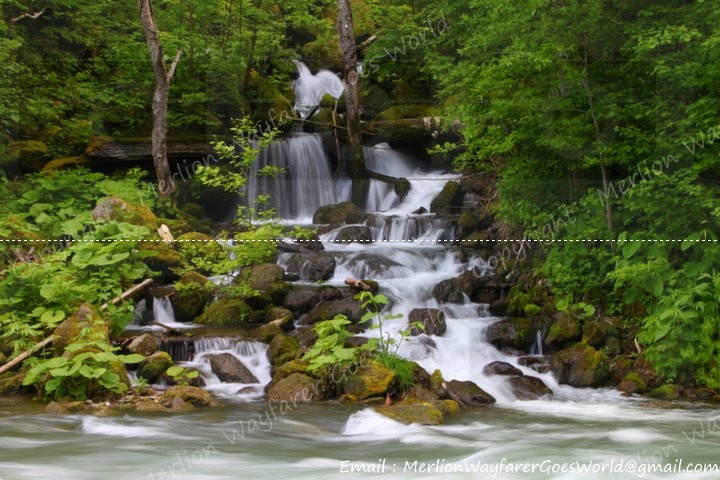
Just a few steps away one sees a pretty little waterfall...

Mounds made from clay are put out on the bridge to dry.
When ready, they will be painted and placed as decorations on the house...

A pretty stone-paved walkway leading from the house...

On the hillocks behind the house, the herd grazes quietly...

How the wood-and-brick house on the hill looks like...


The Family


When Merlion Wayfarer was there, only the mother and the daughter were at home. The feeling she got from interacting with the two was that they were carefree and contented leading their simple lifestyles.


Children exist in carefree surroundings...

A polite girl, she smiled at every camera without fail and said a shy "谢谢" (thank you) for each time she received a packet of candy or snacks...


Ethnic minorities are not limited by the one-child policy, yet each child is the pride and joy of the family...


More photos are available on Merlion Wayfarer Goes World's Picasa at :
Sichuan - The Zangs (藏族人)


Sources


The Zangs - Yak Butter Tea

Dagu Glacier (达谷冰川)
Sichuan (四川), China (中国)
April 2013

Yak butter tea (酥油茶) is a drink of the Tibetans and Chinese minorities in southwestern China. It is also consumed in Bhutan. Made from tea leaves, yak butter, and the optional salt, drinking butter tea is a regular part of Tibetan life. Since butter is the main ingredient, this tea provides plenty of caloric energy and is particularly suited to high altitudes. It is said that the butter may also help prevent chapped lips.

According to the Tibetan custom, butter tea is drunk in separate sips, and after each sip the host refills the bowl to the brim. Thus, the guest never drains his bowl; rather, it is constantly topped off. If the visitor does not wish to drink, the best thing to do is leave the tea untouched until the time comes to leave and then drain the bowl. In this way etiquette is observed and the host will not be offended.

Hot tea cooking on a wood-fire indoor stove. 
A warm respite for the near-zero spring temperatures outisde...

What Merlion Wayfarer ate was the staple food of shepherds who are often out the whole day with their herds of goats or yaks.

Tsampa (糌粑) is a Tibetan staple foodstuff, particularly prominent in the central part of Tibet and southwestern China. Made of roasted flour, usually barley flour and sometimes also wheat flour, it is usually mixed with the Tibetan butter tea. Butter tea is also used for eating tsampa by pouring onto it, or dipping the tsampa into it, and mixing well.

The bowls with the tsampa (the beige powder), a lot of sugar and a slice of yak butter...

Early each morning, each shepherd would bring the tsampa with them, together with their tea in a flask. When it is time for a meal, the tsampa is mixed with the butter tea and kneaded into a dough or paste. A huge dollop of sugar is often added. 

Tour Guide E and the lady of the house serves us piping hot tea...


Bowls in various stages of mixing...


[YouTube Video] This is how it's done:

The end result looks and tastes like sesame paste (芝麻糊). The yak butter tea is like a mild version of English Breakfast Tea with sugar and fresh milk. Despite being made with curdled milk, there is no trace of a cheesy nor buttery taste. Drunk by itself, the warmth of the tea is a welcome respite from the icy highland chill.
  

More photos are available on Merlion Wayfarer Goes World's Picasa at :
Sichuan - The Zangs (藏族人)


Sources


Jiuzhaigou - The Fairyland Of Lakes Made From Wind And Clouds

Jiuzhaigou (九寨沟) 
Sichuan (四川), China (中国)
March 2013

Covering 72,000 ha in the northern part of Sichuan Province, Jiuzhaigou preserves a series of important forest ecosystems including old-growth forests which provide important habitat for numerous threatened species of plants and animals, including the giant panda and the Sichuan takin, a subspecies of Tibetan goat-antelope. Attaining heights of 4,752 m in the southern Minshan Mountains, Jiuzhaigou also contains an important number of well-preserved quaternary glacial remnants with great scenic value.

It is listed on the UNESCO website as "a reserve of exceptional natural beauty with spectacular jagged alpine mountains soaring above coniferous forest around a fairyland landscape of crystal clear, strange-coloured blue, green and purplish pools, lakes, waterfalls, limestone terraces, caves and other beautiful features".

That was why Merlion Wayfarer travelled 4.5 hours by plane and 440km by bus to see it. Merlion Wayfarer faced "Treacherous Mountain Roads" and combated "Altitude Sickness" for all this!

Passing Maoxian (茂县), the road from Chengdu to Jiuzhaigou takes one full day of bus journey, 
or about 7-10 hours...
(Source : ChinaTrekking)

With a development area of 140 square kilometres, the Jiuzhaigou Scenic Area gains its name from its nine Tibetan villages. It is composed of three valleys arranged in a Y shape. The Rize and Zechawa Valleys flow from the south and meet at the centre of the site where they form the Shuzheng Valley, flowing north to the mouth of the valley. The three valleys are 14km, 17km and 18km in length, respectively. 

The paths along these valleys are lined with 55km of roads for shuttle buses, as well as wooden boardwalks and small pavilions. The boardwalks are typically located on the opposite side of the lakes from the road, shielding them from disturbance by passing buses and hordes of tourists.


(Source : TravelGuideChina)

Legend has it that long ago, the mountain deity named Dago had a crush on the goddess Semo. As a token of his love, he gave her a mirror that was made from the wind and the clouds. However, a demon appeared and harrassed Semo. Inadvertently, Semo dropped the mirror in the struggle. The mirror broke into 108 pieces, which fell down to Earth and turned into 108 colorful lakes, called "seas" (海) by the locals.

The ticket to Jiuzhaigou costs RMB 80. This is because Merlion Wayfarer went to Jiuzhaigou on one of the last few days of the off-peak season. From 01 April onwards to 15 November each year, the ticket price goes up to RMB 220.

The ticket comes with a postcard on the right and the ticket stub on the left...

For those deciding between the private bus tour and the public bus service, Merlion Wayfarer gives her two cents' worth in "Jiuzhaigou - The Private Bus Option".


Walking through a souvenir alley first before reaching the entrance of Jiuzhaigou - Good planning!

Today's Forest Fire Risk Level was set to "Danger!". OK, Merlion Wayfarer can swim, and there's lots of water out there...


Fur-clad ticketing attendants scanning the tickets...

RFID boxes along the way to monitor the environment...

Rest pavilions and shopping sites are available at strategic stops along the way...

Some posters about the Jiuzhaigou in a dark tunnel linking a bus parking area from a dining area...

Maybe it was the crowd. Maybe it was because she felt rushed with a limited time at each spot. Maybe it was because she expected fields full of springtime flowers blooming by the waters.  Maybe it was because the waters were just blue and green with only a few other shades. Maybe all the lakes look somewhat similar. And Merlion Wayfarer was indeed disappointed by this "fairyland". But, but, but, the photos look really good!


More photos are available on Merlion Wayfarer Goes World's Picasa at :
Sichuan - Jiuzhaigou (九寨沟)


 Sources 


Jiuzhaigou - Zechawa Valley

Jiuzhaigou (九寨沟) 
Sichuan (四川), China (中国)
March 2013
    

Zechawa Valley (则查洼沟)


The Zechawa Valley (则查洼沟) is the south-eastern branch of Jiuzhaigou. It is approximately the same length as Rize Valley at 18km but climbs to a higher altitude (3150 m at the Long Lake). Going downhill from its highest point, it features the following sites:


Long Lake (长海)

Crescent-shaped Long Lake (长海) is crescent-shaped and is the highest, largest and deepest lake in Jiuzhaigou, measuring 7.5km in length and an average depth of 44m with the its deepest bank at 103m.


It reportedly has no outgoing waterways, getting its water from melted snow and losing it from seepage. There is no visible tributary around the lake but the water source is the melted snow from the South Peak and the waters of surrounding mountain streams and brooks. It is a wonder that the Long Lake neither runs dry in the winter and spring, nor brims over the bank in the rainy summer and autumn. Local Tibetans call the lake "a magic gourd that will never be poured full or dried up".


There is a cypress on the bank of Long Lake with an odd shape. On one side of the tree, the branches and leaves are rich and abundant, but on the opposite side, the trunk is bare. The tree is known as Jiuzhaigou's "one-armed old man" (独臂老人).


According to legend, Jiuzhaigou was once ruled by a ferocious demon. An elderly brave hunter from a remote mountain came here and fought the demon at Long Lake. He succeeded in driving away the demon but lost one arm during the struggle. In order to prevent the demon ever coming back, the old hunter, armed with a sword, stood on the bank of Long Lake day and night. He guards Jiuzhaigou still.

Tibetan prayer flags abound on the shores and trees around Long Lake. 
For RMB 5, one can purchase these to toss on the slopes for good luck...

Photo props and digital photography services are available for rental - 
RMB 20 per person for the costumes and RMB 30 per photo...

The lake is surrounded by imposing mountains on both sides...

Five-Colour Pond (五彩池)


Five-Colour Pond (五彩池) is famous for its crystal clear water in the Jiuzhaigou Nature Reserve. Despite its very modest dimensions and depth, it has a richly-coloured underwater landscape in its crystal clear blue water. Covering an area of 5,645 square metres, it is one of the smallest lakes in Jiuzhaigou.


Located a short distance from Long Lake (长海) at an elevation 2,995m above sea level, it gets some of its water from from the lake. Within its depths, there are patches of light green, milky white, bright yellow, deep blue, and turquoise. This is due to the aquatic lifeforms such as plankton,  sponges, algae, and ferns that inhabit the water. The different plant life produces varying percentages of chlorophyll. A high concentration of travertine (CaCO3), a light-coloured porous calcite, is deposited into the water, forming among other deposits, stalactites and stalagmites, resulting in the different colours of the water.


According to legend, the pond was where the love-smitten mountain deity Dage came daily to bring water for the goddess Semo to wash her hair.

Is that why there is a heart in the pond?


More photos are available on Merlion Wayfarer Goes World's Picasa at :
Sichuan - Jiuzhaigou (九寨沟)