Bali Hai

The cotton wool clouds, the fine grains of black volcanic sands, the clean sea waters - one can just lie on the beach and while the time away with a tan beneath the balmy tropical sun...

The Volcanic Islets Of Onuma

Ōnuma Park is known for its picturesque, island dotted lakes and majestic dormant volcano, Mount Komagatake. Surrounded by birch and maple forests, a total of 128 small islands can be found in its lakes...

A Journey Over Mountains & Waters

A land of rocky mountains, snaking rivers, steep slopes, deep valleys, and harsh barren terrain. Yet in some places, lush greenery and crystal-clear azure waters abound...

The Bluest Pacific Seas

In the middle of the Pacific Oceans lies an archipelago of islands formed from the fiercest violent volcanoes and made of the browns and greys of cooled lava rocks. The resulting landscape is breathtaking in its purest greens and blues...

Sounkyo's Silver Streams

Bordered by 100-metre cliffs formed by the erosion of tuff, Sounkyo Gorge is situated at the foot of Mount Daisetsuzan - the "roof of Hokkaido", and stretches for 24 kilometres along the Ishikari River...

Showing posts with label Jiuzhaigou. Show all posts

Jiuzhaigou Folk Culture Village - The Crafts

Jiuzhaigou Folk Culture Village (九寨沟民俗文化村)
Sichuan (四川), China (中国)
March 2013

After going round the Nine-Treasure Lotus Stupa (九宝莲花菩提塔) outside the Jiuzhaigou Folk Culture Village (九寨沟民俗文化村), Merlion Wayfarer stepped past the entrance of the village...

A broad main street leads from the gateway...

Products made from yak horn... and pelts!

Beautiful hair pins displayed on a straw hat...

Dolls dressed in traditional costumes...


A stuffed yak head with lots of stuffed pandas - An interesting pairing...

Local produce for sale... 

An interesting way to display carbonated drinks, and look - a post box!

Colourful decorations adorn each building...

Local artisans making yak horn combs...


More photos are available on Merlion Wayfarer Goes World's Picasa at :
Sichuan - The Zangs (藏族人)


Jiuzhaigou Folk Culture Village - The Stupa

Nine-Treasure Lotus Stupa (九宝莲花菩提塔)
Jiuzhaigou Folk Culture Village (九寨沟民俗文化村)
Sichuan (四川), China (中国)
March 2013

(This article is part of Merlion Wayfarer Goes World's People series on The Zangs.)
  
At the entrance to the Jiuzhaigou Folk Culture Village (九寨沟民俗文化村), one of the nine villages in Jiuzhaigou, a grand stupa resides...


A stupa is a form of Buddhist structure found in the Indian subcontinent, across Asia and worldwide. The earliest Buddhist religious monument, it was originally made of a simple mound made of clay, and found mainly at the entrance to a village, or in open barren areas. These evolved into large hemispherical mounds with additional features, e.g. the mehdi (a circumambulatory path around the stupa), the torana (the gateway), the vedica (a fence-like enclosure originating from the Vedic period), the harmika (a square platform on top of the stupa), and chattrayashti (the parasol or canopy). Each of the components of the stupa is rich in metaphoric content and is identifiable with the five cosmic element - earth, water, fire, air and space.

The Tibetan monk onsite informed Merlion Wayfarer walking five times round the mehdi
while turning the prayer wheels would be ideal. If not, at least once.... 

The local animist Benbos are the caretakers of the stupas within Jiuzhaigou. As the pre-Buddhism religion of the Himalayas, the Ben religion perceives natural physical entities - including animals, plants, and often even inanimate objects or phenomena - as having a spiritual or godly essence. In this way, local believers are perceived as excellent guardians of the local traditional and natural heritage.

The flags lining the vedica are not just plain coloured flags. 
Each has a religious symbols and text printed or written on it...

The nine stupas within Jiuzhaigou reflect the original history of the stupa. After Buddha passed away, his remains were buried in eight stupas along the path of his epic pilgrimage journey. At the ninth stupa, the urn and embers were placed together with scriptures and other religious artifacts. In this way, the nine stupas are religiously significant for today's Buddhist and Bon believers. In Jiuzhaigou, the tradition of the nine stupas fit in with the cultural tradition as here being the "Valley of the Nine Villages".

Next, Merlion Wayfarer ventures into the village to view the range of Tibetan Crafts available...


More photos are available on Merlion Wayfarer Goes World's Picasa at :
Sichuan - The Zangs (藏族人)


The Zangs - Jiuzhaigou Folk Culture Village

Jiuzhaigou (九寨沟)
Sichuan (四川), China (中国)
March 2013

(This article is part of Merlion Wayfarer Goes World's People series on The Zangs.)

Merlion Wayfarer visited the Jiuzhaigou Folk Culture Village (九寨沟民俗文化村), one of the nine Tibetan villages in Jiuzhaigou. Although it was largely commercialized (By right, locals don't usually sit there in their villages to wait for people to buy their wares!), it was an interesting insight into the range of crafts made by the Tibetans...

|     Nine-Treasure Lotus Stupa     |     Tibetan Crafts     |

An azure lake just steps away from the village. Such is the beauty of the place...

The entrance of the village with its grand gateway, colourful buildings and wooden buildings...


More photos are available on Merlion Wayfarer Goes World's Picasa at :
Sichuan - The Zangs (藏族人)


The Zangs - A Visit To A Tibetan Household

Dagu Glacier (达谷冰川)
Sichuan (四川), China (中国)
March 2013

Merlion Wayfarer was fortunate that her travel itinerary included a visit to a Zang household. After seeing many houses along the way, it was indeed fascinating to be finally going inside one!
   

A Wood-And-Brick House

 
The house is a short walk from the road. This is probably due to the admirable efforts of the government to improve the living conditions of the ethnic minorities.

The house as seen from the outside. Over in this village,
there are no need for tall fences to keep people out...

The exterior of the house is made from split stones glued together with clay...

Like several other ethnic minorities,
a cattle skull placed over the front door guards over the entrance to the house... 

The Tibetan-style windows are distinctive with their U-shapes and colourful frames... 

The heavy front door with a tinge of Chinese influence in its lion head brass knocker...

Warm In Winter, Cool In Summer

 
Due to the freezing sub-zero temperatures in winter, the houses built must be suitable for the weather conditions. These houses are warm in winter and retain heat well, yet are cool in summer when the temperature hits 30 degrees Celsius.

Blue-tinted indoor neon lights...

Beautiful woven carpets with plant motifs...

The family's utensils are placed in polished handcrafted cupboard which fit snugly into the wall recess...

Longings of Potala in Lhasa are hinted in this poster 
stretching the half the length of the entire living room...

According to Tour Guide C, this house has no flush toilets. Running water is via the river behind the house. Due to the cold weather, there are no bathing facilities. If need be, hot water is boiled in a tub for a bath.

Yak Butter Tea


It was in such cosy conditions that Merlion Wayfarer and her group got to enjoy the warm hospitality of the Tibetan family and a warm cup of "Yak Butter Tea" heated over a stove started with a wood fire.


The Outside

 
Upon stepping out of the three-storeyed house...

Cattle and yaks roam about freely on the streets of the village...

Beware where you step! Lots of landmines around...

Their "garden'" is an indication of their simple lifestyle...

It does take a lot of effort to cut down all the trees and split this amount of firewood!

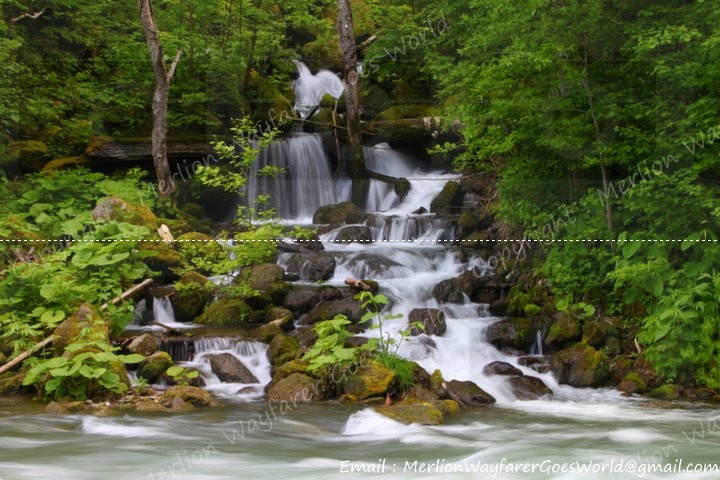
Just a few steps away one sees a pretty little waterfall...

Mounds made from clay are put out on the bridge to dry.
When ready, they will be painted and placed as decorations on the house...

A pretty stone-paved walkway leading from the house...

On the hillocks behind the house, the herd grazes quietly...

How the wood-and-brick house on the hill looks like...


The Family


When Merlion Wayfarer was there, only the mother and the daughter were at home. The feeling she got from interacting with the two was that they were carefree and contented leading their simple lifestyles.


Children exist in carefree surroundings...

A polite girl, she smiled at every camera without fail and said a shy "谢谢" (thank you) for each time she received a packet of candy or snacks...


Ethnic minorities are not limited by the one-child policy, yet each child is the pride and joy of the family...


More photos are available on Merlion Wayfarer Goes World's Picasa at :
Sichuan - The Zangs (藏族人)


Sources