Bali Hai

The cotton wool clouds, the fine grains of black volcanic sands, the clean sea waters - one can just lie on the beach and while the time away with a tan beneath the balmy tropical sun...

The Volcanic Islets Of Onuma

Ōnuma Park is known for its picturesque, island dotted lakes and majestic dormant volcano, Mount Komagatake. Surrounded by birch and maple forests, a total of 128 small islands can be found in its lakes...

A Journey Over Mountains & Waters

A land of rocky mountains, snaking rivers, steep slopes, deep valleys, and harsh barren terrain. Yet in some places, lush greenery and crystal-clear azure waters abound...

The Bluest Pacific Seas

In the middle of the Pacific Oceans lies an archipelago of islands formed from the fiercest violent volcanoes and made of the browns and greys of cooled lava rocks. The resulting landscape is breathtaking in its purest greens and blues...

Sounkyo's Silver Streams

Bordered by 100-metre cliffs formed by the erosion of tuff, Sounkyo Gorge is situated at the foot of Mount Daisetsuzan - the "roof of Hokkaido", and stretches for 24 kilometres along the Ishikari River...

The Chrysanthemum Path To Enlightenment In Hiraizumi

Hiraizumi (平泉), Iwate (岩手)
Tohoku, Honshu, Japan
Autumn 2009


Hiraizumi in the southwestern part of Iwate Prefecture is a town extending up the Hiraizumi Hill on the west bank of the Kitakami-gawa River, that prospered for almost 100 years from the 11th to 12th centuries as the center of the Tohoku region (the northeastern region). Over 3,000 national treasures and historical sites still remain, telling of the Fujiwara Clan that reigned over the area in the zenith of its prosperity. The splendid culture that appeared during the reign of the Fujiwaras lasted for three generations and has been preserved in the area to this day.

The sun was setting as we arrived here from Sendai...
  
During the Chūsonji Chrysanthemum Festival, the temple grounds are filled with a wide variety of exquisite chrysanthemum displays set against the brilliant foliage of autumn...
 
  
Hiraizumi's largest and most famous temple, renowned particularly for its Golden Hall (金色堂 Konjikidō) — which, unlike Kyoto's Golden Pavilion, is housed inside a large glass case. True to the name, the shrine inside is elaborately decorated with golden lacquer and mother-of-pearl, with three Buddha images. Entry a rather steep ¥800. 5 minutes by bus or 20 on foot from the station...

Devotees offer their thanks for the blessings in their lives...

As we left, we embarked on our own "stairway to heaven" by ascending a misaligned flight of stairs...


The full album is available at:
Chrysanthemum Path To Enlightenment In Hiraizumi

Matsushima - The Seascape That Left Basho Speechless

Matsushima (松島), Miyagi (宮城)
Tohoku, Honshu, Japan
Autumn 2009

For many centuries, the people of Japan have been designating the best and most beautiful places and events in their country: there are Japan's top three gardens, Kyoto's top five Zen temples, Japan's top three festivals featuring floats, Kamakura's top ten wells and countless other rankings. Most famous among the many designations are probably Japan's three most scenic places, nihon sankei (日本三景). Selected several centuries ago, they consist of Matsushima, Miyajima and Amanohashidate:


Matsushima is located in the central part of Miyagi Prefecture. Some 260 islands, large and small, are scattered in picturesque Matsushima Bay. The view of Matsushima changes from place-to-place and from-season-to-season, and is so beautiful that it is considered one of the three most beautiful sites in Japan. Dotted with small islands covered by black and red pines and grayish white rocks, the views of Matsushima Bay from the four islands of Ogi-ga-tani, Tomi-yama, Otaka-mori, and Tamon-zan are truly spectacular, which is called "Matsushima Shidaikan," the four grandest views in Matsushima. With its stunning island scenery, the place is frequented by visitors all year round. 

By day, it is a quiet port with fishermen dozing at their boats and boats berthed at the bay...


Autumn panoramas from the Zuigan-ji Temple (瑞巌寺)...
Picturesque scenes as we ascend upwards for one of the 4 scenic views of the bay...

"The View"...


Souvenirs sold in the shops near the bay - kokeshi dolls, 100 million yen notes, porcelain monks...
A plethora of seafood is sold at affordable prices in scenic dining environments...
Views from and of islands in the middle of the bay...
  

Of Hakone's Feudal Lords, Samurai Warriors & Elegant Princesses

Hakone (箱根), Kanagawa (神奈川)
Kanto, Honshu, Japan
Autumn 2009

On Culture Day, a Japanese national holiday, a procession of a total of 170 people dressed up as samurai warriors and princesses parades over a distance of some 6 km in Yumoto Onsen, the hot spring town.

The procession is reproduced in the style of the Daimyo Gyoretsu (feudal lord's procession) which was also known as "sankin kotai" during the Edo Period (1603-1867). The suite of retainers, each assigned with his role, and armed with spear, bow and arrow, or gun, march on as they carry their lord in the palanquin to the words, "Down! Down! The Lord comes!" voiced aloud by those leading the procession.

Sankin-kōtai (参勤交代, literally "alternate attendance", a daimyo's alternate-year residence in Edo) was a policy of the shogunate during most of the Edo period of Japanese history. It was a system established by the Tokugawa Shogunate reigning over Japan back then to prevent its subordinate feudal lords from rising in rebellion. In principle, each daimyo was required to furnish a number of soldiers (samurai) in accordance with the assessment of his han. These soldiers accompanied the daimyo on the processions to and from Edo. By obliging the daimyo lords to go back and forth between their domains and Edo (present-day Tokyo) in alternate years, the Shogunate Government aimed at weakening their financial power.

At 10 o'clock in the morning, the Hakone Daimyo Gyoretsu departs from Sounji Temple, and while carrying out diverse activities on the way, arrives at Yumoto Fujiya Hotel, the final destination, a little past 2 o'clock in the afternoon. The festival is made all the more merry by the performances of the marching bands accompanying the daimyo procession at the front and at the very end, and the dance performances by the geigi unique to hot spring resorts (Geigi are women who entertain guests at sake parties with song and dance).


The crowd at the Hakone station upon arrival...

Fumbling around unfamiliar territory with a sketchy map...

Road closures along the way...

The start of the procession with the very first flag-bearers...
 

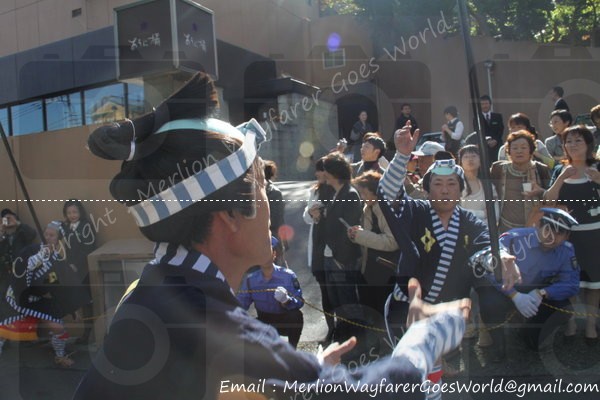
  The solemn-looking ojisans who did not carry any props except the long blue satchels...
There were exciting performances along the way...
 

Including the one that threw the pole way too near us!
 

Reaching the Yumoto Fujiya Hotel for the half-way point break...

Joining hotel guests and cleaners who view from the rooms above...

Performers await in anticipation for the start of the next part of the procession... 
 
 
Watching cheerleading and band performances while we await...


With the tastefully-dressed geiji troupes...
Columns and columns of them!


"Geijis" who perform - with track shoes!

We finally realize what the ojisans' blue satchels were for...
 
Enterprising street vendors set up stalls along the route...
Sure glad that we were early - See the crowd now!

It was all worth it!

Source