


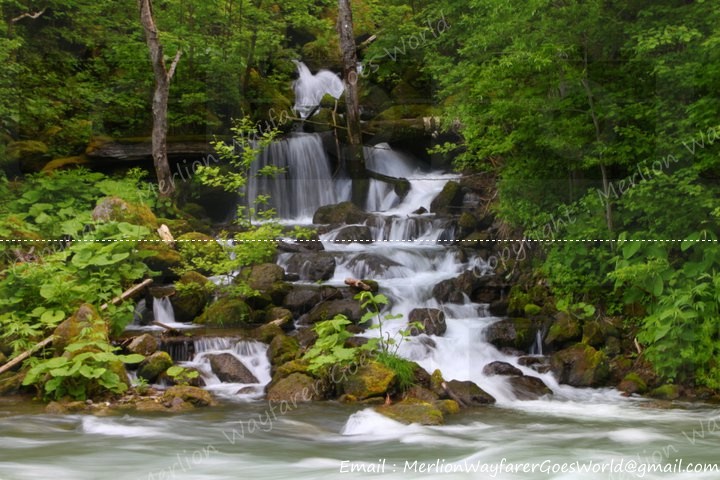
Hakone (箱根), Kanagawa (神奈川)
Kanto, Honshu, Japan
Autumn 2009

On Culture Day, a Japanese national holiday, a procession of a total of 170 people dressed up as samurai warriors and princesses parades over a distance of some 6 km in Yumoto Onsen, the hot spring town.
The procession is reproduced in the style of the Daimyo Gyoretsu (feudal lord's procession) which was also known as "sankin kotai" during the Edo Period (1603-1867). The suite of retainers, each assigned with his role, and armed with spear, bow and arrow, or gun, march on as they carry their lord in the palanquin to the words, "Down! Down! The Lord comes!" voiced aloud by those leading the procession.
Sankin-kōtai (参勤交代, literally "alternate attendance", a daimyo's alternate-year residence in Edo) was a policy of the shogunate during most of the Edo period of Japanese history. It was a system established by the Tokugawa Shogunate reigning over Japan back then to prevent its subordinate feudal lords from rising in rebellion. In principle, each daimyo was required to furnish a number of soldiers (samurai) in accordance with the assessment of his han. These soldiers accompanied the daimyo on the processions to and from Edo. By obliging the daimyo lords to go back and forth between their domains and Edo (present-day Tokyo) in alternate years, the Shogunate Government aimed at weakening their financial power.
At 10 o'clock in the morning, the Hakone Daimyo Gyoretsu departs from Sounji Temple, and while carrying out diverse activities on the way, arrives at Yumoto Fujiya Hotel, the final destination, a little past 2 o'clock in the afternoon. The festival is made all the more merry by the performances of the marching bands accompanying the daimyo procession at the front and at the very end, and the dance performances by the geigi unique to hot spring resorts (Geigi are women who entertain guests at sake parties with song and dance).
The crowd at the Hakone station upon arrival...

Fumbling around unfamiliar territory with a sketchy map...

Road closures along the way...


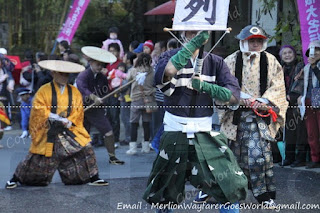

Including the one that threw the pole way too near us!


Joining hotel guests and cleaners who view from the rooms above...


Watching cheerleading and band performances while we await...


"Geijis" who perform - with track shoes!


Autumn 2009

On Culture Day, a Japanese national holiday, a procession of a total of 170 people dressed up as samurai warriors and princesses parades over a distance of some 6 km in Yumoto Onsen, the hot spring town.
The procession is reproduced in the style of the Daimyo Gyoretsu (feudal lord's procession) which was also known as "sankin kotai" during the Edo Period (1603-1867). The suite of retainers, each assigned with his role, and armed with spear, bow and arrow, or gun, march on as they carry their lord in the palanquin to the words, "Down! Down! The Lord comes!" voiced aloud by those leading the procession.
Sankin-kōtai (参勤交代, literally "alternate attendance", a daimyo's alternate-year residence in Edo) was a policy of the shogunate during most of the Edo period of Japanese history. It was a system established by the Tokugawa Shogunate reigning over Japan back then to prevent its subordinate feudal lords from rising in rebellion. In principle, each daimyo was required to furnish a number of soldiers (samurai) in accordance with the assessment of his han. These soldiers accompanied the daimyo on the processions to and from Edo. By obliging the daimyo lords to go back and forth between their domains and Edo (present-day Tokyo) in alternate years, the Shogunate Government aimed at weakening their financial power.
At 10 o'clock in the morning, the Hakone Daimyo Gyoretsu departs from Sounji Temple, and while carrying out diverse activities on the way, arrives at Yumoto Fujiya Hotel, the final destination, a little past 2 o'clock in the afternoon. The festival is made all the more merry by the performances of the marching bands accompanying the daimyo procession at the front and at the very end, and the dance performances by the geigi unique to hot spring resorts (Geigi are women who entertain guests at sake parties with song and dance).
The crowd at the Hakone station upon arrival...

Fumbling around unfamiliar territory with a sketchy map...

Road closures along the way...


The start of the procession with the very first flag-bearers...


The solemn-looking ojisans who did not carry any props except the long blue satchels...


There were exciting performances along the way...


Including the one that threw the pole way too near us!

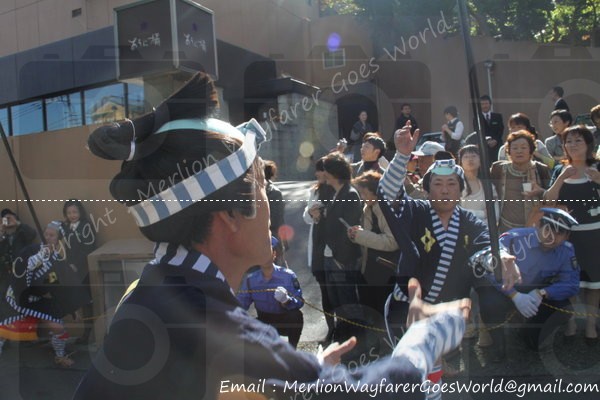

Reaching the Yumoto Fujiya Hotel for the half-way point break...

Joining hotel guests and cleaners who view from the rooms above...

Performers await in anticipation for the start of the next part of the procession...


Watching cheerleading and band performances while we await...


With the tastefully-dressed geiji troupes...


"Geijis" who perform - with track shoes!


We finally realize what the ojisans' blue satchels were for...


Enterprising street vendors set up stalls along the route...


Sure glad that we were early - See the crowd now!


It was all worth it!

The full album is available at:
Of Hakone's Feudal Lords, Samurai Warriors & Elegant Princesses
Source
- "Hakone Daimyo Gyoretsu (Feudal Lord's Procession in Hakone)" (14 April 2012). Japan National Tourism Organization (JNTO). Retrieved from http://www.jnto.go.jp/eng/attractions/event/traditionalevents/a60_fes_hakone.html.
- "Sankin-kōtai" (15 April 2012). Wikipedia. Retrieved from http://en.wikipedia.org/wiki/Sankin-k%C5%8Dtai.


